

Lean Six Sigma in the Age of Artificial Intelligence
Businesses today are operating in an environment shaped by data, automation, and rapid technological change. Artificial intelligence is no longer a future concept. It is already influencing how organizations analyze information, make decisions, and improve operations.
At the same time, many companies continue to rely on structured improvement methodologies to manage processes and maintain quality. This raises an important question: how does Lean Six Sigma fit into a world driven by AI?
Understanding lean six sigma in the age of artificial intelligence helps organizations see how traditional process improvement methods are evolving alongside modern technology.
Lean Six Sigma has always focused on improving efficiency, reducing waste, and enhancing quality through structured problem-solving. AI introduces new capabilities that can accelerate these improvements, especially in areas such as data analysis, process monitoring, and decision-making.
Rather than replacing Lean Six Sigma, artificial intelligence is transforming how it is applied. Organizations are now combining structured methodologies with advanced technologies to achieve faster and more accurate results.
What Is Lean Six Sigma in the Age of Artificial Intelligence?
Lean Six Sigma in the context of artificial intelligence refers to the integration of traditional process improvement methods with modern AI-driven technologies.
Traditionally, Lean Six Sigma relies on structured frameworks such as DMAIC to analyze processes, identify inefficiencies, and implement improvements. These methods are built on data analysis, but much of the work has historically been manual.
With the introduction of AI, many of these processes are becoming more automated and data-driven.
For example, AI systems can analyze large datasets much faster than humans, identify patterns that are not immediately visible, and provide insights that support decision-making.
This evolution represents the growing role of ai in lean six sigma.
Instead of replacing the methodology, AI enhances it by:
- accelerating data analysis
- improving accuracy in identifying process issues
- enabling predictive insights
- supporting faster decision-making
Lean Six Sigma still provides the structure. AI improves how efficiently that structure is applied.
Why Lean Six Sigma Still Matters in an AI-Driven World
As organizations adopt artificial intelligence, some assume that traditional improvement methods may no longer be necessary. However, this is not the case.
AI is a powerful tool, but it does not replace structured thinking.
Lean Six Sigma remains important because it provides a clear framework for identifying problems, analyzing root causes, and implementing improvements.
Without this structure, AI systems may generate insights, but organizations may struggle to apply them effectively.
Lean Six Sigma ensures that:
- problems are clearly defined
- data is interpreted correctly
- solutions are tested and validated
- improvements are sustained over time
AI enhances these steps, but it does not replace them.
The combination of Lean Six Sigma and AI creates a balanced approach.
Lean Six Sigma provides the methodology.
AI provides speed, scale, and advanced analytical capabilities.
This combination allows organizations to improve processes more efficiently while maintaining control and consistency.
How AI Is Transforming Lean Six Sigma Processes
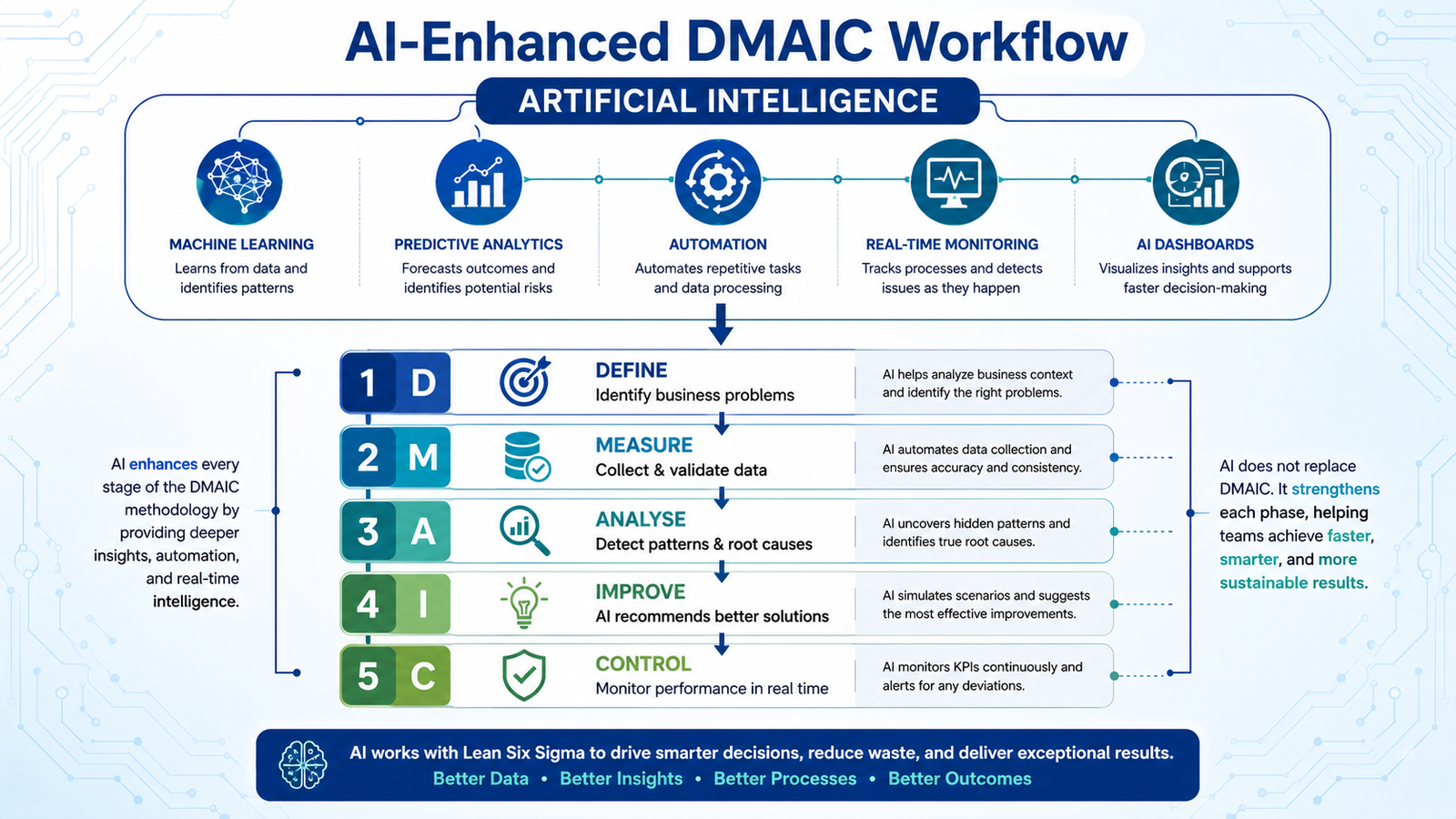
Artificial intelligence is changing how organizations apply Lean Six Sigma by improving speed, accuracy, and decision-making capabilities.
Several areas of the methodology are being transformed.
Automation of Data Collection
One of the most time-consuming aspects of traditional Lean Six Sigma projects is data collection.
Teams often spend significant time gathering information from different systems, verifying data accuracy, and organizing datasets for analysis.
AI reduces this effort by automatically collecting and organizing data from multiple sources.
This allows improvement teams to focus more on analysis and decision-making rather than manual data preparation.
Advanced Data Analysis
AI systems can process large volumes of data quickly and identify patterns that may not be obvious through manual analysis.
Machine learning algorithms can detect trends, anomalies, and relationships within data, providing deeper insights into process performance.
This improves the accuracy of root cause analysis and helps organizations make more informed decisions.
Real-Time Process Monitoring
Traditional Lean Six Sigma projects often rely on historical data.
AI enables real-time monitoring of processes through dashboards and automated systems.
Organizations can track performance continuously and identify issues as they occur rather than after problems have already impacted operations.
This shift allows for faster response times and more proactive process management.
Intelligent Decision-Making
AI supports decision-making by providing predictive insights based on historical and real-time data.
For example, predictive models can forecast potential process failures, allowing organizations to take preventive action before problems occur.
This level of insight enhances the effectiveness of Lean Six Sigma improvement initiatives.
AI vs Traditional Lean Six Sigma
| Traditional Lean Six Sigma | Lean Six Sigma with AI |
|---|---|
| Manual data collection | Automated data collection |
| Historical data analysis | Real-time data analysis |
| Reactive problem solving | Predictive problem solving |
| Manual root cause analysis | AI-assisted pattern detection |
| Periodic performance reviews | Continuous process monitoring |
| Human-generated reports | AI-powered dashboards |
| Longer project timelines | Faster decision-making |
Lean Six Sigma with AI: Key Technologies
The integration of Lean Six Sigma and artificial intelligence is supported by several key technologies.
These tools enable organizations to analyze data, automate processes, and improve decision-making.
| Technology | Role in Lean Six Sigma |
| Machine Learning | Predict process outcomes and identify patterns |
| Robotic Process Automation (RPA) | Automate repetitive tasks |
| Predictive Analytics | Forecast process performance and risks |
| AI Dashboards | Provide real-time monitoring and insights |
Machine learning allows systems to learn from data and improve over time.
RPA helps automate routine tasks, reducing manual effort and improving efficiency.
Predictive analytics enables organizations to anticipate problems before they occur.
AI dashboards provide visibility into process performance, allowing teams to monitor results continuously.
These technologies strengthen the ability to apply lean six sigma with ai in modern business environments.
Real-World Applications of AI in Lean Six Sigma
Organizations across industries are already combining AI with Lean Six Sigma to improve operational performance. These applications show how technology enhances traditional improvement methods.
Manufacturing
In manufacturing environments, AI is used to improve quality control and equipment performance.
Predictive maintenance systems analyze machine data to identify potential failures before they occur. This reduces downtime and improves production efficiency.
AI is also used in defect detection, where computer vision systems identify product defects more accurately than manual inspection.
Healthcare
Healthcare organizations use AI to improve patient flow and clinical decision-making.
For example, hospitals apply predictive analytics to manage patient admissions and reduce waiting times. AI systems can also assist in identifying patterns in patient data that support diagnosis and treatment decisions.
These improvements align closely with how lean six sigma in healthcare is used to improve operational efficiency and patient outcomes.
Supply Chain
Supply chain operations benefit from AI through improved forecasting and logistics optimization.
Organizations use AI to predict demand, optimize inventory levels, and improve delivery routes. These improvements reduce delays and increase supply chain reliability.
This approach is closely related to lean six sigma for supply chain optimization, where data-driven decisions help streamline logistics and reduce operational inefficiencies.
Benefits of Combining AI with Lean Six Sigma
The integration of AI with Lean Six Sigma provides several practical advantages for organizations.
These benefits go beyond traditional process improvement and enable faster, more accurate decision-making.
Faster decision-making
AI systems analyze large datasets quickly, allowing organizations to make decisions in real time.
Reduced human error
Automation reduces the risk of errors associated with manual data processing and repetitive tasks.
Improved process efficiency
AI helps identify inefficiencies and optimize workflows more effectively than traditional methods alone.
Better predictive insights
Predictive analytics allows organizations to anticipate problems and take preventive action.
Scalability
AI-powered systems can handle large volumes of data and processes, making it easier to scale improvement initiatives across an organization.
These advantages highlight the value of applying lean six sigma with ai in modern business environments.
Challenges of Integrating AI with Lean Six Sigma
While the combination of AI and Lean Six Sigma offers many benefits, organizations may face challenges when implementing these technologies.
Data quality issues
AI systems rely on accurate data. Poor data quality can lead to incorrect insights and ineffective decisions.
High implementation costs
Advanced AI technologies often require significant investment in software, infrastructure, and training.
Skill gaps
Organizations may lack professionals who understand both Lean Six Sigma and AI technologies.
Resistance to change
Employees may be hesitant to adopt new systems or change established workflows.
Overcoming these challenges requires strong leadership, proper training, and a clear implementation strategy.
Future of Lean Six Sigma in the AI Era
The integration of AI with Lean Six Sigma is expected to grow as organizations continue adopting digital technologies.
Future developments may include:
AI-assisted DMAIC processes
AI tools may support each phase of DMAIC by providing automated data analysis and recommendations.
Autonomous process improvement systems
Advanced systems could automatically detect inefficiencies and implement improvements with minimal human intervention.
Industry 4.0 integration
Lean Six Sigma will increasingly align with Industry 4.0 technologies such as smart factories, IoT devices, and real-time analytics systems.
These advancements will further enhance the ability of organizations to improve processes and maintain competitive advantages.
Frequently Asked Questions
Can AI replace Lean Six Sigma?
No. AI enhances Lean Six Sigma by improving data analysis and decision-making, but the methodology itself provides the structure needed for effective process improvement.
How is AI used in Lean Six Sigma projects?
AI is used to automate data collection, analyze large datasets, identify patterns, and provide predictive insights that support improvement initiatives.
Is Lean Six Sigma still relevant in the AI era?
Yes. Lean Six Sigma remains highly relevant because it provides a structured framework for problem-solving, which is essential for applying AI insights effectively.
Can small businesses use AI with Lean Six Sigma?
Yes. Small businesses can use AI with Lean Six Sigma to automate repetitive tasks, analyse customer data, and improve workflows without investing in expensive enterprise systems. Many cloud-based AI tools are affordable and can support process improvement projects of any size.
What skills are needed to combine AI and Lean Six Sigma?
Professionals benefit from understanding Lean Six Sigma principles, data analysis, problem-solving, and basic AI concepts. Familiarity with machine learning, predictive analytics, and data visualisation tools can also help organisations apply AI more effectively during improvement projects.
Which industries benefit the most from AI and Lean Six Sigma?
AI and Lean Six Sigma are widely used in manufacturing, healthcare, logistics, finance, retail, telecommunications, and customer service. Organisations in these industries use AI to improve decision-making, reduce waste, optimise operations, and enhance customer experiences.
Conclusion
Lean Six Sigma continues to play a critical role in helping organizations improve processes, reduce waste, and enhance quality.
Understanding Lean Six Sigma in the age of artificial intelligence shows how traditional improvement methods are evolving alongside modern technology and supporting digital transformation Lean Six Sigma initiatives across industries.
Artificial intelligence does not replace Lean Six Sigma. Instead, it strengthens the methodology by enabling faster analysis, real-time monitoring, and more accurate decision-making.
Organizations that combine structured process improvement with advanced AI technologies are better positioned to improve efficiency, adapt to change, and maintain long-term success.
Training programs offered by Lean Six Sigma Global help professionals develop the skills needed to apply Lean Six Sigma methods alongside modern technologies, enabling organizations to achieve meaningful and sustainable improvements.