

What Is a Lean Six Sigma Process? Understanding Flow, Waste & Quality
Imagine a factory where materials move seamlessly from one station to another, with zero waiting time, no excess inventory, and products that meet specifications every single time. Sounds impossible? That’s exactly what Lean Six Sigma processes achieve.
But what is six sigma lean processes exactly, and how do they differ from regular business processes? More importantly, how can understanding these principles transform your organization’s performance?
In this guide, you’ll discover the fundamental elements that define Lean Six Sigma processes, understand how flow, waste elimination, and quality work together, and learn practical ways to apply these concepts in any industry.
Defining What Is a Process in Lean Six Sigma
Before exploring Lean Six Sigma processes specifically, let’s clarify what we mean by “process” in this context.
A process is any series of activities that transforms inputs into outputs. Processes exist everywhere: manufacturing products, processing insurance claims, serving customers in restaurants, developing software, or treating patients in hospitals.
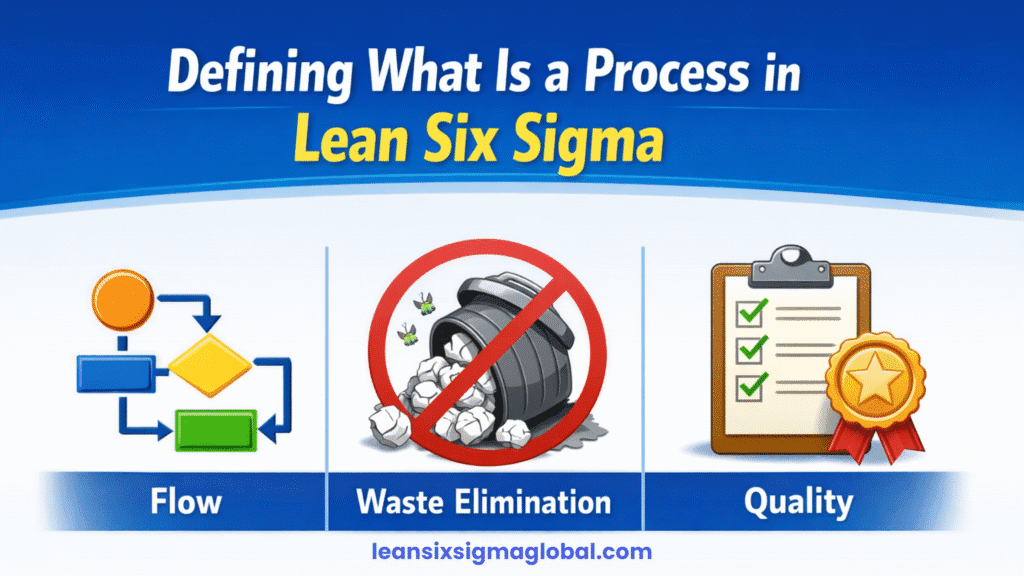
What is a process in lean six sigma? It’s a series of interconnected activities designed to deliver value to customers with maximum efficiency and minimum defects. Three core principles define these processes:
- Flow: Work moves smoothly without interruptions, delays, or bottlenecks
- Waste Elimination: Activities that don’t add value are systematically removed
- Quality: Outputs consistently meet customer requirements with minimal variation
Understanding What Is Lean Six Sigma? A Complete Beginner-Friendly Explanation provides the foundation for seeing how these elements work together to create superior performance.
The Dual Heritage: Lean + Six Sigma
The lean six sigma methodology combines two powerful improvement philosophies, each contributing distinct strengths.
The Lean Contribution: Speed and Flow
Lean originated from the Toyota Production System and focuses on eliminating waste to accelerate flow. The principle is simple: anything that doesn’t add value from the customer’s perspective is waste that should be removed.
Lean identifies eight types of waste: overproduction, waiting, transportation, excess inventory, motion, defects, over-processing, and unused talent. Each represents activities that consume resources without creating value for customers.
The Six Sigma Contribution: Precision and Quality
Six Sigma, detailed in What Is Six Sigma? Core Concepts, History & Real-World Use Cases, focuses on reducing variation and eliminating defects through data-driven analysis. The goal is achieving near-perfect quality with no more than 3.4 defects per million opportunities.
When combined, Lean accelerates processes while Six Sigma ensures quality doesn’t suffer from increased speed. This synergy creates processes that are both fast and reliable.
Key Characteristics of Lean Six Sigma Processes
Effective Lean Six Sigma processes share several defining characteristics:
Customer Value Focus: Every activity is evaluated through the customer’s lens. Does this step add value they’re willing to pay for? This ruthless focus prevents organizations from perfecting activities customers don’t care about.
Continuous Flow: Work moves smoothly from one step to the next without waiting, batching, or backtracking. Continuous flow reduces cycle time and improves responsiveness.
Pull Rather Than Push: Production or service delivery is triggered by actual customer demand rather than forecasts. This prevents overproduction and reduces inventory.
Built-In Quality: Quality is created during the process, not inspected afterward. Mistake-proofing devices and standard procedures prevent defects from occurring.
Data-Driven Decisions: Teams use What Is the DMAIC Process? Step-by-Step Framework Explained to systematically analyze performance and implement improvements.
Standardized Work: Best practices are documented and followed consistently, creating predictable performance and baseline for improvement.
Understanding Flow in Lean Six Sigma
Flow represents how smoothly work moves through a process. Poor flow creates delays, increases costs, and frustrates customers.
Common flow disruptions include bottlenecks where work piles up, batch processing that delays individual items, rework loops that send defective work backward, and handoffs between departments that create waiting time.
Strategies for improving flow include balancing workloads across process steps, reducing batch sizes, eliminating unnecessary handoffs, co-locating related activities, and cross-training employees to handle multiple tasks.
Organizations pursuing certification often learn flow analysis techniques during training. Many wonder How Long Does Six Sigma Certification Take? Full Timeline Breakdown as they develop these skills.
The Eight Wastes: Targets for Elimination
Lean Six Sigma processes systematically attack waste in all forms:
Overproduction: Making products before customers need them ties up resources and leads to excess inventory.
Waiting: Idle time where nothing productive happens represents pure waste, including machines waiting for materials or information waiting for approval.
Transportation: Moving materials or information unnecessarily adds no value and creates handling costs.
Inventory: Excess inventory hides problems, consumes space, and ties up capital.
Motion: Unnecessary movement by people—walking to retrieve tools or searching for information—accumulates into significant time loss.
Defects: Errors require rework, consume additional resources, and may reach customers causing dissatisfaction.
Over-Processing: Adding features customers don’t value or processing to tighter tolerances than required wastes resources.
Talent: Not utilizing people’s skills and creativity represents perhaps the most significant waste.
Quality in Lean Six Sigma Processes
Quality means consistently meeting customer requirements. Lean Six Sigma processes achieve this through multiple mechanisms:
Process Capability: Understanding whether your process can naturally produce results within customer specifications through statistical analysis.
Variation Reduction: Identifying and eliminating sources of inconsistency, distinguishing between random variation and assignable causes.
Mistake-Proofing: Designing processes so errors are impossible or immediately obvious through devices like color coding or sensors.
Control Systems: Monitoring key metrics to detect when processes drift from target performance, enabling quick correction.
Practical Application: Transforming a Process
Let’s examine how Lean Six Sigma principles transform a typical insurance claims process:
Original Problems: Claims took 15 days with 25% requiring rework. Customers called repeatedly for updates, overwhelming customer service.
Analysis: Process mapping revealed seven handoffs with claims waiting 3 days between each step. Data showed 60% of delays occurred waiting for medical records verification.
Improvements: Redesigned claim forms with clear instructions, created standardized work procedures, implemented single-piece flow for simple claims, automated status notifications, and cross-trained staff.
Results: Average processing time dropped to 5 days, rework rate fell to 5%, customer satisfaction increased 40%, and staff productivity improved 35%.
Measuring Process Performance
Effective processes require measurement across multiple dimensions:
Quality Metrics: Defect rates, first-pass yield, customer complaints, and specification compliance
Speed Metrics: Cycle time, lead time, throughput, and on-time delivery
Efficiency Metrics: Cost per unit, resource utilization, and value-added time ratios Flexibility Metrics: Changeover time and response time to customer requests
Balanced measurement prevents optimizing one metric while harming others.
Building a Lean Six Sigma Culture
Sustaining improvements requires organizational culture change:
Leadership Commitment: Leaders must visibly support efforts, allocate resources, and participate in training.
Employee Engagement: Frontline workers possess invaluable process knowledge. Involving them in improvements builds ownership.
Continuous Improvement Mindset: Viewing current performance as today’s baseline rather than the destination.
Systematic Problem-Solving: Using structured approaches like the lean six sigma methodology rather than fighting fires reactively.
Getting Started
Organizations beginning their journey should start with one process having obvious problems, train key personnel through certification, measure current performance before changes, document improved methods in standard procedures, and celebrate successes broadly.
Conclusion: The Power of Process Excellence
So, what is six sigma lean processes? They’re systematically designed workflows that eliminate waste, maintain smooth flow, and deliver consistent quality. They represent a fundamentally different approach based on customer value, data-driven decisions, and continuous improvement.
Understanding what is a process in lean six sigma means seeing every activity through the lens of value, flow, and quality. The lean six sigma methodology provides practical tools for transforming ordinary processes into sources of competitive advantage.
Ready to transform your organization’s processes and drive exceptional results?
Lean Six Sigma Global offers comprehensive training programs that teach you how to analyze, improve, and sustain world-class processes. Our practical courses provide the knowledge and tools you need to eliminate waste, improve flow, and deliver superior quality.
Visit Lean Six Sigma Global today and discover how our certification programs can transform your career and your organization’s performance.